
Anyone who spends any time on the internet has one eye peeled for scammers. I’ve used eBay for many years for many online purchases and have generally had a good experience. Usually it’s small stuff like like LEDs and bike parts for the DateTrike, coax connectors and cable for my radio, new or used test equipment, or parts for home appliances gone bad that are relatively easy to find on eBay. I’ve bought used ham radios, solar panels and an induction cook-top via eBay, bigger purchases, still with no problems. So it was somewhat a surprise recently when purchases of a hank of speaker wire and a few power transistors both generated dubious results.
The key to keeping people honest on eBay is the “feedback” system of reviews from buyers and sellers. With so many vendors, the theory goes, only those with stellar “positive feedback” scores can survive the competition. But it turns out that some of the biggest players are the worst offenders. So what is going on?
Wire Scam
Lets take a look at my first experience. Just a bunch of speaker wire advertised as #16, but then when it arrived it was #20.

I notified the seller. They had me start the return process; I sent it back – post paid – and a few days later received my money back. In the mean time I left “Feedback” that was “Neutral,” because of the waste of time due to the incorrect listing. I was a blot on their 99.1 % “Positive” feedback. Yet, a few days later when I went back to check on my comment in the seller’s feedback, it had disappeared. The seller did take down the offending listing. So maybe some quid-pro-quo with the eBay enforcers? So much for “feedback” meaning much of anything. And what was the point? Was it just a mistake or were the sellers trying to foist #20 wire on unsuspecting buyers? Eventually I learned the answer in terms of eBay’s Seller Protections – including this one:

I suspect that the main reason they wanted to run the refund through eBay’s “Money Back Guarantee” is that guarantee’s there will be no bad feedback! Hence you can do a marginally shady business and have a way out if someone complains.
A Baseball-Card-Dealer-Turned-Lawyer Viewpoint
Doing a little research, I found a great legal review article on this problem by Andrew Lehrer [1], whose first business was selling baseball cards on eBay, well before he went to law school. His analysis comes from an intimate understanding of the platform. The article starts with a great example of what goes down way too often on eBay:
Jack decided to buy his girlfriend, Jill, the blue Burberry handbag that she had been eyeing for months. Before buying the bag directly from the Burberry website for the retail price of $500, he realized that he might be able to locate the bag for a cheaper price elsewhere. A Google search for the bag brought him to eBay.com, where much to his delight he found exactly the same bag for half the price. Concerned both that the price was “too good to be true” and that the bag might be a counterfeit, Jack looked at the eBay seller’s feedback. The seller had over 5000 positive reviews from eBay buyers. Furthermore, the seller listed his location as Des Moines, Iowa – hardly the counterfeit capital of the world. Jack purchased the bag, confident that he got an amazing bargain.
A week later, he received the bag and it looked great; he surprised Jill that night with the fantastic present. She was thrilled, but her excitement quickly turned to disappointment. Jill, a handbag connoisseur, noticed the material was not quite right and the tags were fake – the bag was a cleverly disguised counterfeit.
Jack, furious, left the seller negative feedback and contacted the seller to demand his money back. The seller politely responded to the e-mail, denied that the bag was fake, and offered a full refund once the bag was returned. Jack did as instructed and received a full refund. He went onto eBay a few weeks later and noticed the same exact seller was selling the same exact Burberry bag, describing it as “new” and “authentic.” Jack also discovered that the seller was listing other Burberry and designer bags well below retail value. Concerned, Jack reported to eBay that this seller sent him a fake bag and that the seller was listing several similar bags. Jack received a response from eBay that it would investigate the matter, but to date the seller continues to sell bags at prices well below retail value.
The scenario described above is common, and the market for counterfeit products is thriving.
Lehrer goes on to describe the fraught situation between all of the stakeholders. Besides the rights and responsibilities of buyers and sellers, there are the rights of trademark and copyright holders, as well as the responsibility of eBay to ensure that its “no counterfeit” policies are adhered to, while not infringing on legitimate sellers of legitimate goods. Who determines that an item is a fake? Is there recourse for a seller falsely accused? Does eBay have too much incentive just to look the other way, when sales of counterfeit items generate a significant fraction the traffic that is eBay’s bread and butter?
Counterfeit Transistors
Into this fray I stepped when I bought ten 2N3771 power transistors to replace the ones on my Astron 35A power supply for my ham radio. I was noticing when transmitting, the voltage would suddenly drop down during the middle of the transmission, then recover when I stopped pushing power. I put the supply on the bench and determined that two of the four output transistors were not functioning. In this circuit, the four transistors are all in parallel so it is a good idea to replace them all at once with identical components. So I went to look for some new ones from a reputable supply house and came back with a lot of “Not Available.”
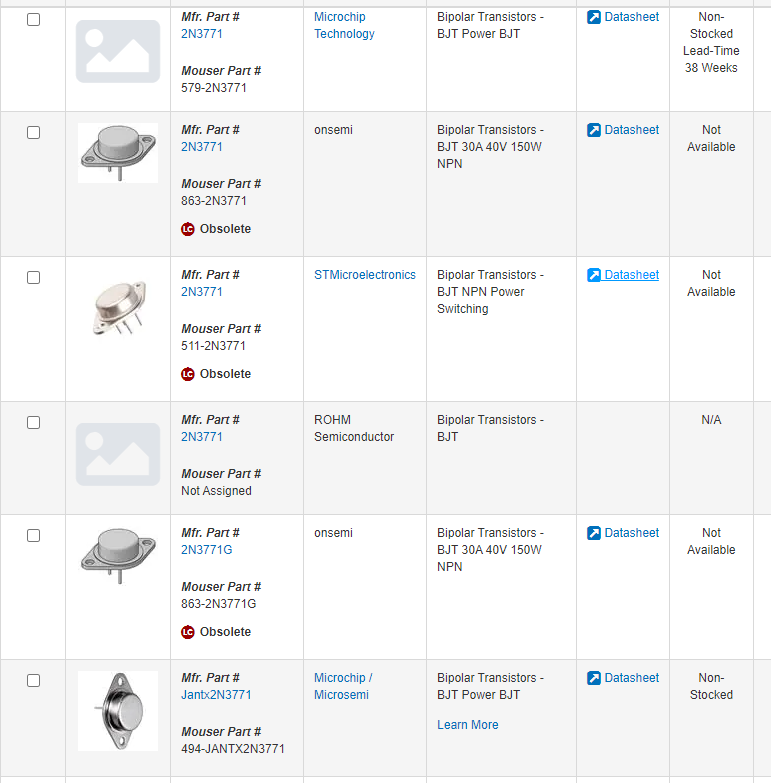
These old parts are just not very popular any more! After DigKey gave the same result I went over to eBay looking for someone’s leftover stock. There was a large variety to choose from, but I needed at least four pieces, so I was drawn to this ad…
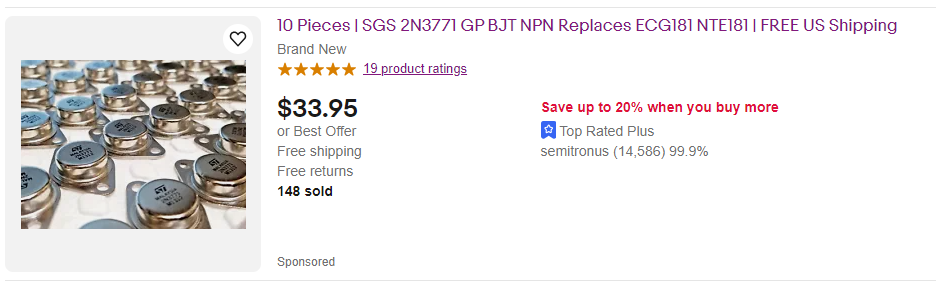
What could go wrong, “Brand New”, “148 sold”, “Sponsored”, “Top Rated Plus”, 99.9% positive rating! ?
I could have gotten similar parts on Amazon as this page of search results show.

In most cases the parts ship from a US address but the seller is a parts distributor located in China. Logos and printing on the Amazon images can be found on parts marketed on eBay and AliExpress. Many parts include a “MEXICO” marking, curious for parts coming from China. Some parts appear to have logos removed. Trying to repair old equipment challenges the standard supply chain, so what many of us are looking for is new old stock (NOS), parts sitting is some warehouse that manage to turn up on the secondary market. But old transistors are pretty “generic,” and it is not hard to build something that at first blush looks like the real thing but only reveals its limitations when pushed.
When my parts came, I put them in the supply and turned it on. There was a brief buzz and then silence. All the new transistors died simultaneously in less than one second!
Once I realized I had purchased counterfeit parts, I went back to look again for parts from more reliable distributors. I eventually found some NTE parts that should prove adequate. NTE is a last resort repairman’s parts source. They specialize in “replacement parts” for a wide variety of OEM parts, often somewhat stretching what is a suitable “replacement,” but at least there is somebody minding the store!
In retrospect you can see why the 2N3771 makes a good candidate to counterfeit. It is a fairly generic part, originally made by several companies and used in lots of old equipment. The big boys aren’t making it anymore, so demand is quite high on the secondary market.
The problems inherent in counterfeit hardware and electronics are a little different than for copyright or trademark infringement of a handbag or a music DVD. This 2N3771 is a good example where there isn’t much intellectual property at stake with a 40 year old part. You can get data sheets from half a dozen manufactures that all look pretty much the same, so a Chinese fab could make a fake 2N3771 that would work like a real 2N3771 if it wanted to. Transistors with ‘2N’ numbers are registered with their specification with the Joint Electron Devices Engineering Council (JEDEC) to facilitate multiple sourcing of parts from various manufacturers. This practice has gradually gone out of favor as semiconductors have become more complex, but for legacy parts with 1N or 2N numbers, the specifications are open for all to view. Any manufacturer that builds to such a specification can label his part with the 2N number and everyone should be happy. However, also important to buyers is the marking on the case that shows the logo of the manufacture. In China there is very little respect for trademarks. And China is rife with middle men, ready to buy and distribute whatever you want to give them. If there is no way to identify the real Chinese manufacturer, and if you are selling just a fake name brand, then there is little incentive to make what is inside very good either – just make it cheaply and fake the ‘2N’ specification as well.
If you were an eBay seller in the US and wanted to sell some 2N3771’s you could look over on alibaba.com or Aliexpress, the Chinese online marketplace and business bazar for the parts.

Here you can find my coveted 2N3771, five for < $3 from many vendors. Some vendors claim “New Copy,” others show logos of a major brand, some just show the part number on the advertised items. If you are the eBay seller and purchase such parts for resale in your eBay store, you just trust what you get at face value and are as “surprised” as your buyer when something bad turns up. I was curious about the prevalence of fakes and variations in quality; I ordered three sets of the 2N3771’s from three different vendors from China using AliExpress.
When they arrived, I did not get exactly what was pictured in the adds. In the photos below, the top row is what I got, the bottom row what they pictured in the listings.
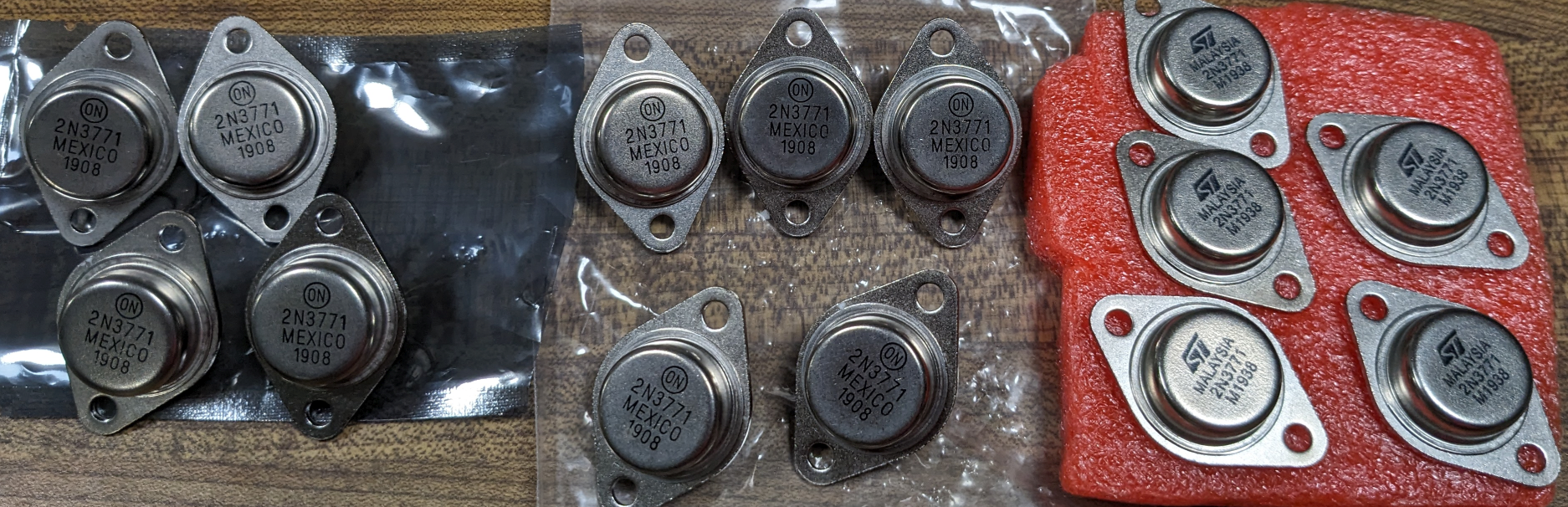
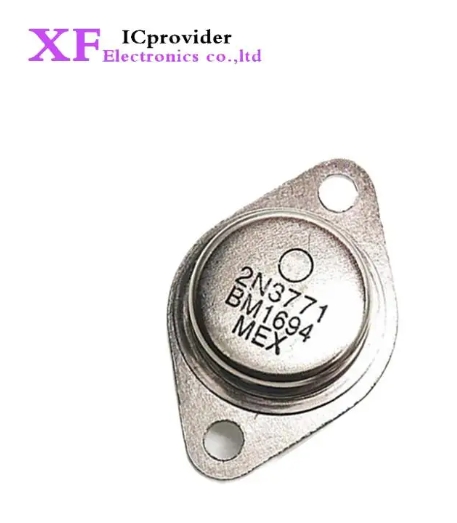
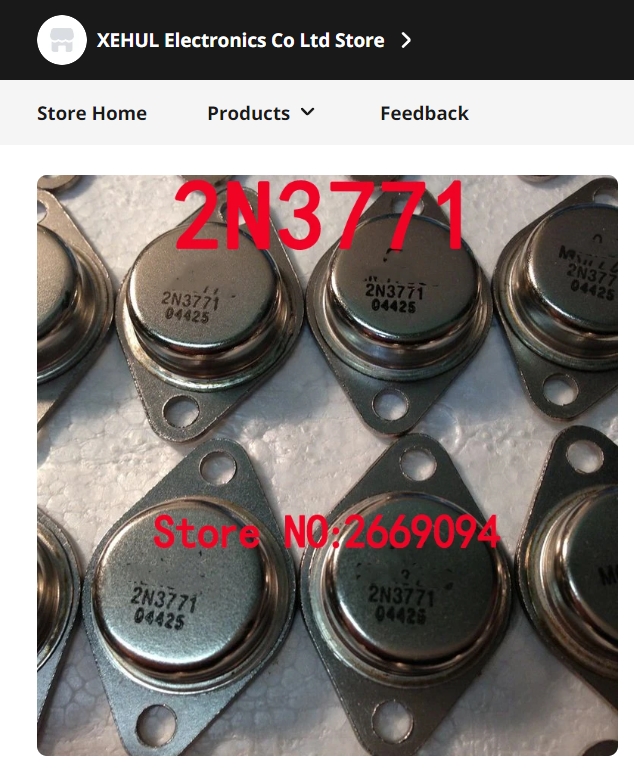
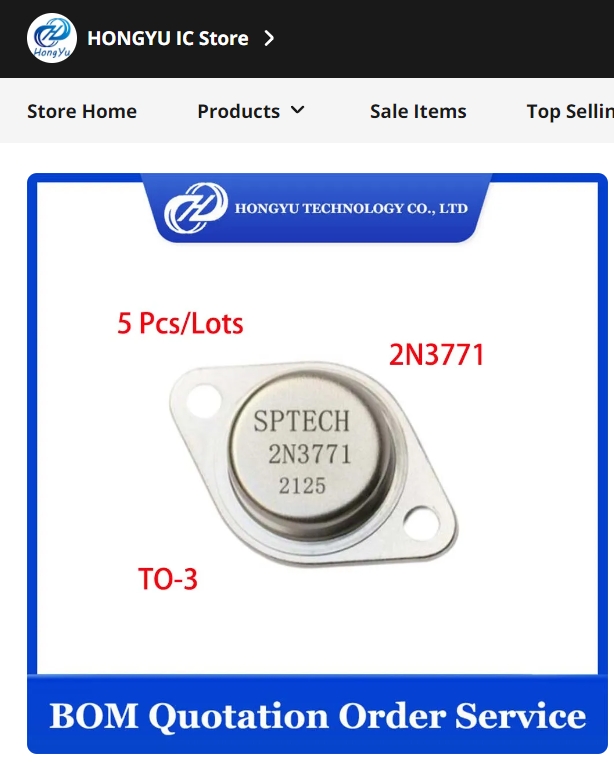
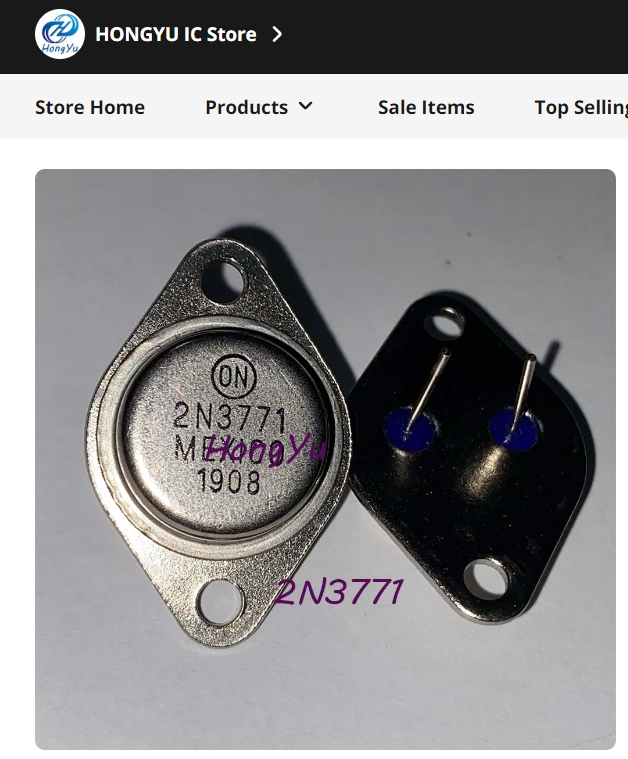
I received two sets with ON MEXICO 1908 markings and one set with the ST MALAYSIA M1938 markings which were just like the ones I got from eBay.
Transistor Teardowns
We will take a little break here to figure out what a 2N3771 should look like, and what I actually bought. I cut the caps off the TO-3 cases with a Dremel tool and measure anything I could think of with the multimeter and a caliper. The table below lists the measured physical parameters for several transistors marked as 2N3771.
| ON Astron Original 2N3771 | old RCA 2N3771 | Ebay ST Fake 2N3771 | AliExprs XFE | AliExprs XEHUL | AliExprs HONGYU | NTE 2N3771 | |
| Vbe, Vbc | 0.55 | 0.45? | 0.63 | 0.55 | 0.55 | 0.63 | 0.53 |
| Wirebond diameter fusing current | 0.022″ 30A | Fat strap | 0.006″ 5A | 0.014″ 17A | 0.014″ 17A | 0.006″ 5A | ? |
| Weight (gm) | 12.0 | 13.0 | 9.5 | 9.8 | 9.8 | 9.5 | 14.7 |
| Die Area (mm2) | 25 | 42 | 4 | 16 | 16 | 4 | ? |
| markings | ON Astron Mexico BM0406 | RCA | ST Malaysia M1938 | ON MEXICO 1908 | ON MEXICO 1908 | ST Malaysia M1938 | NTE 2317LF |
Looking at what is inside tells the story. First the good parts. In the photo below, the part on the left is an RCA transistor I’ve had around in my junk box since the ’80s. The part on the right is one of the ones from my power supply that I’m trying to replace.
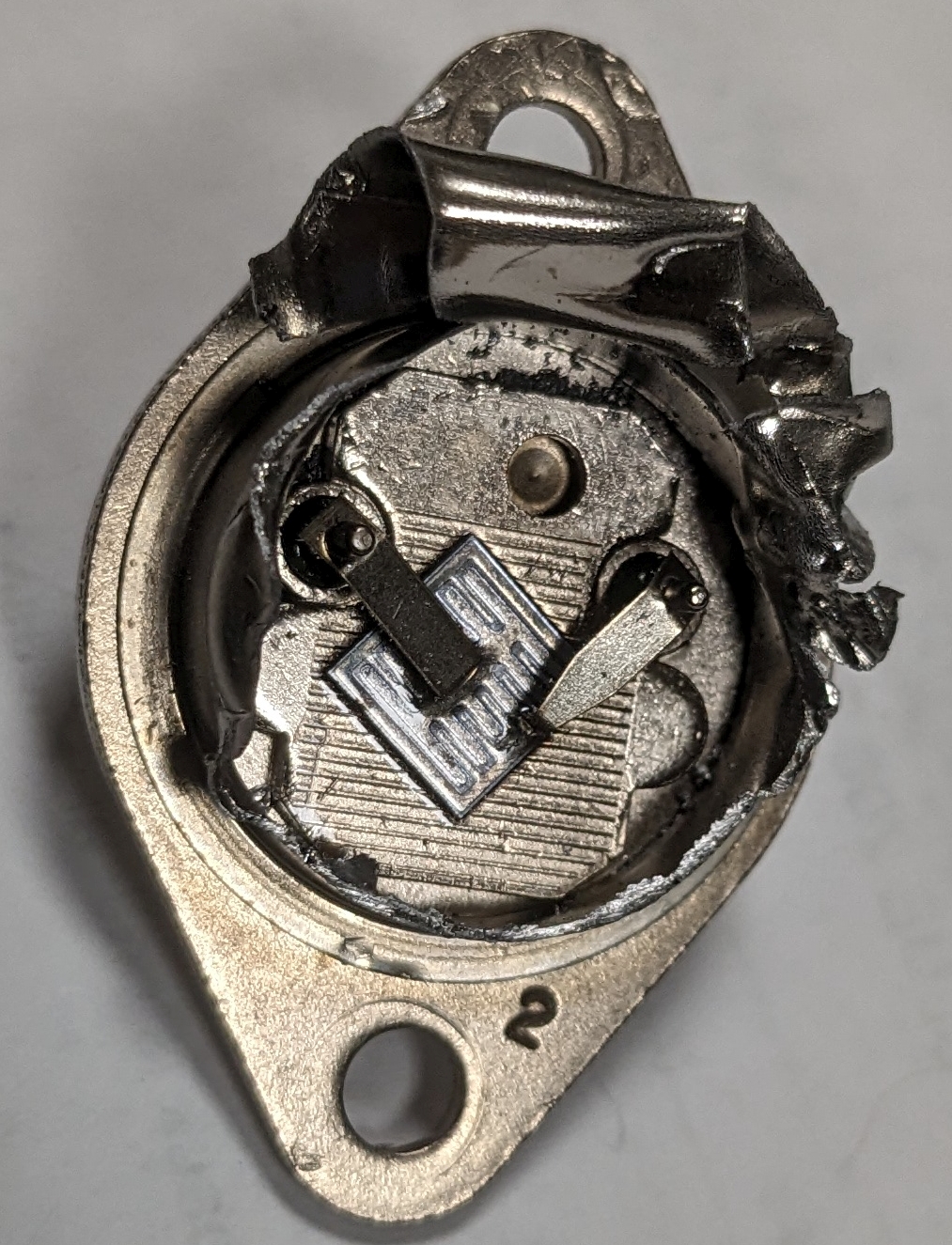
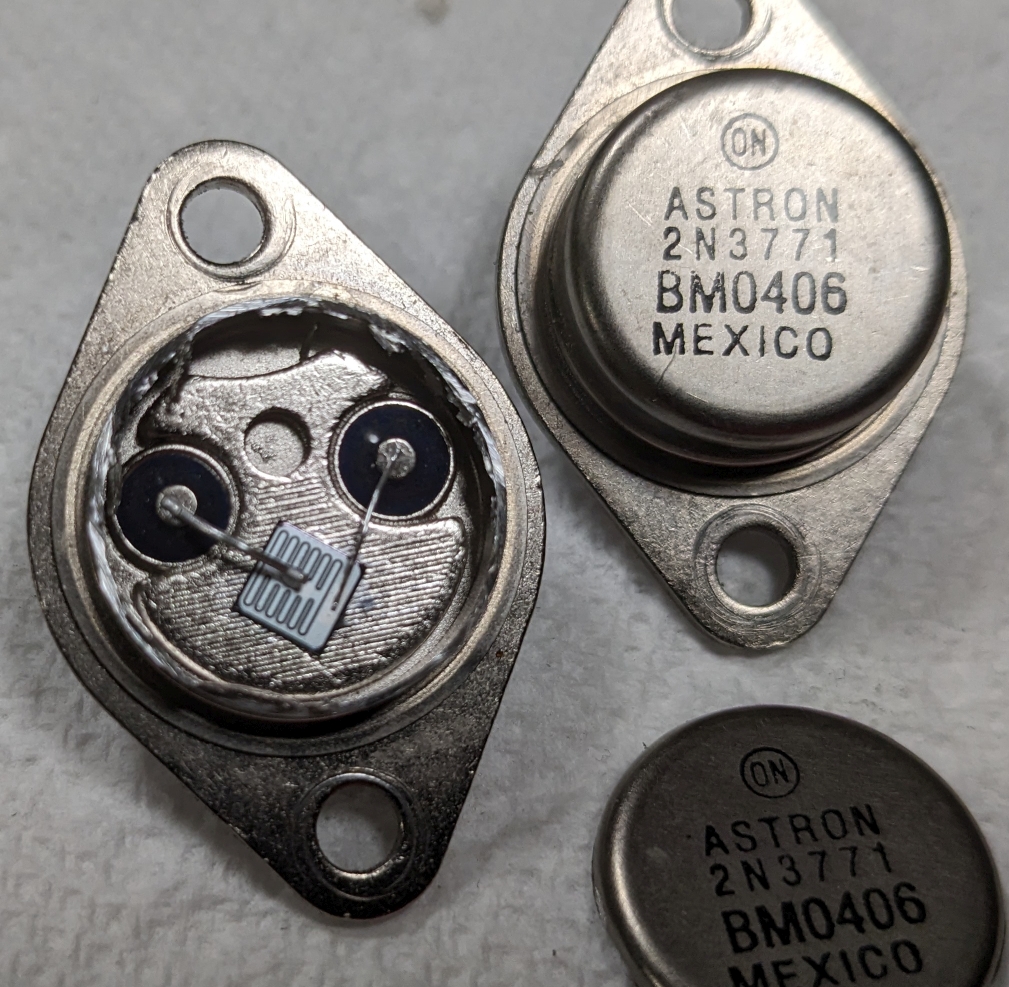
In both cases, note the “heat spreader” under the chip, a bulky chunk of copper to improve the heat conduction through the steel flange. The real parts weight several grams more than the fake ones because of that copper heat spreader. The main current carrying wire is the left-side one in the photos. You see a big strap in the 1980’s part and a large diameter wirebond in the newer part. Wirebonds are often a failure point in high current parts because they can fuse. The fusing current of round copper wires is well tabulated and gives you a direct measure of a common failure mode for the peak current capability of such a part.
On to the fakes. Everything I found on AliExpresss and eBay were one of either of these two fakes. The one on the left is a little better than the one on the right, but neither will do the job of a real 2N3771.
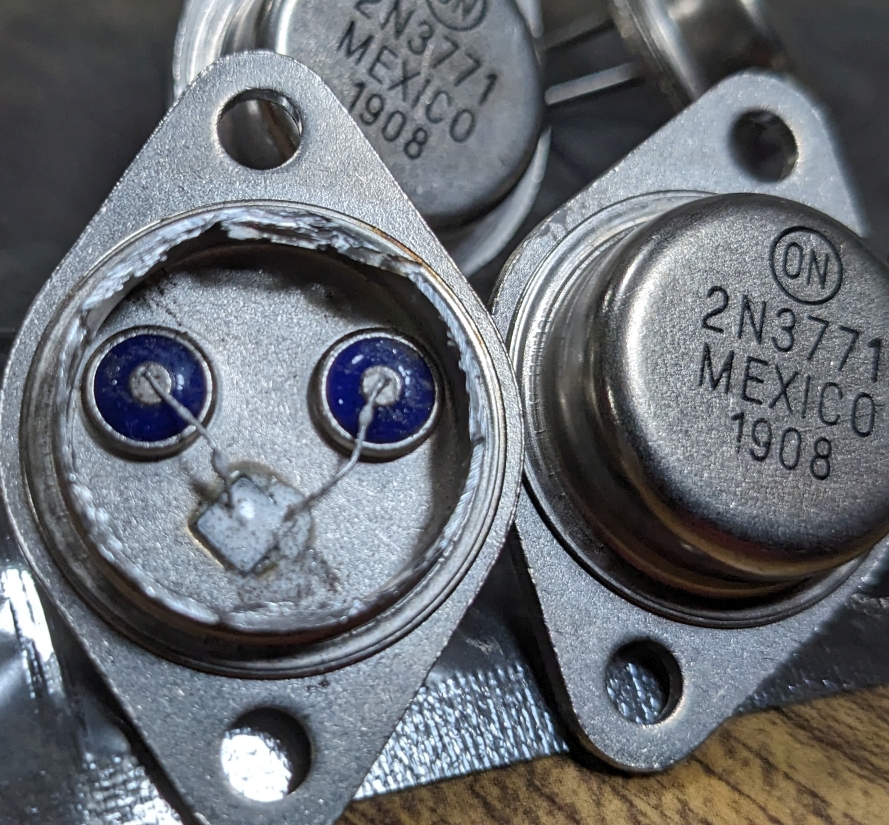
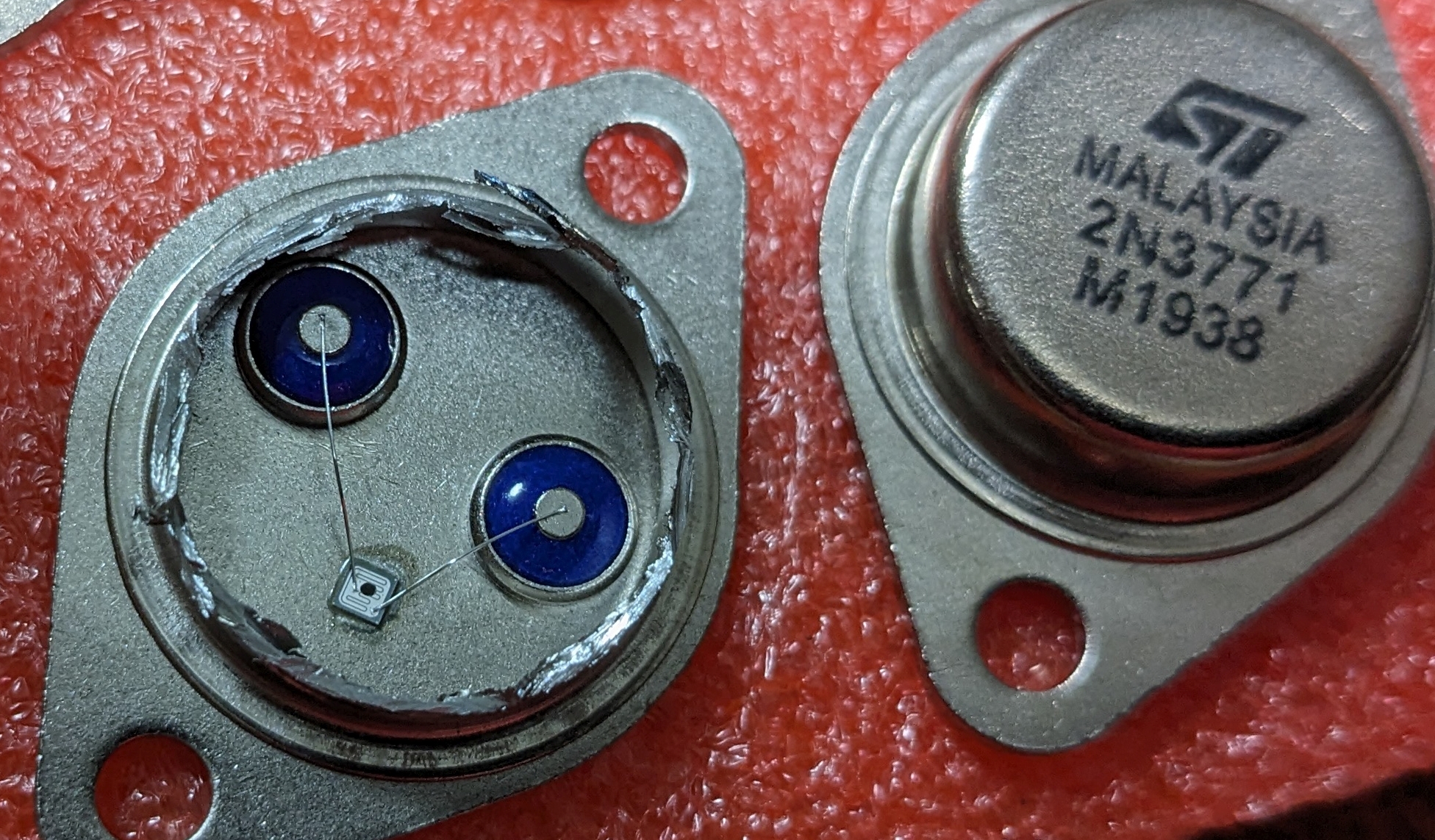
First, there are no heat spreaders. the small die is placed directly on the poor thermally conducting steel flange so any heat generated by the die will be slow to leave and get the chip much hotter. Chip area is smaller on the fake, but the confession that “I am a fake” is with the bond wires. Remember, according to the spec, this part needs to conduct 30 A for a short period of time without failing. My measurements suggest the wirebonds will fuse at about 17 A and 5 A for the left and right images above respectively. Compare with the good Astron part above.
Comparing fakes, the one with the slightly bigger bond wires and die area (ON MEXICO 1908) is a much better part than the other one. If the equipment the part was used in had enough derating built into the design, the transistor might function for a while. But the transistor junction will get very hot when pushed at all. Repeated large thermal cycles will kill even the best parts, so if the fakes don’t fail immediately, they will after a few cycles. I was fortunate that when I put the parts of the other fake (ST MALAYSIA M1938) with tiny wirebonds into my supply, they failed the minute I turned on the power. Otherwise I might have thought everything was OK.
eBay’s Complicity
One lesson I learned with this event is the extent to which eBay is engineered to let this kind of thing happen. Although they have a User Agreement that sets out what buyers and sellers can and can’t do, there is not much in it that restricts sellers from lying in their listings.[2] What eBay is concerned about is willfully allowing for trademark infringement because they could be liable for knowingly allowing sales of counterfeit or trademark infringing goods on their platform. To that end, they have the Verified Rights Owner (VeRO) program which allows the trademark owners to request removal of listing they feel are infringing on their intellectual property. The fraudulent semiconductor merchant I ran into did indeed defraud the SGS-Thompson brand with the ST logo on the goods they sold, but buyers have no method or standing to report such an infringement at eBay. The JEDEC specification for a 2N3771 transistor was also not met in the parts marked with the 2N3771 part number, but that is not an intellectual property issue, that is just lying about what is inside the case of the part marked with “2N3771.” SGS-Thompson could take down this listing if they cared enough, but remember that an attorney would need to write some letters complaining about parts which the company no longer even make. The lawyer could be earning his pay much better negotiating purchase agreements with Boeing or General Motors for supply contracts worth real money.

Hence, we are left to rely on eBay’s feedback and review system to self-police the marketplace. And here again we bump into seller-friendly policies that seemed designed to whitewash dubious sellers. Case in point is my effort to warn buyers about the bad transistors I had purchased. I gave negative “feedback” to the seller and explained in detail why. The seller attempted to cajole me into changing my feedback comments by pointing out that he had refunded my money. A fair point, but his listings remained in place, as did my negative feedback. Many buyers are happy to receive items on time and give a positive feedback before they even know that what they received was defective.
Several days later, eBay’s algorithms reached out to me for a “review” of the parts I had purchased. Besides seller “feedback” there are also product “reviews” that are specifically linked to identifiable products (via product codes of some sort) which could be listed by several sellers. Now things get tricky. Because of eBay’s VeRO policy, only “rights owners” can file a claim that counterfeit products are being listed. Buyers are not “rights owners” so any claim they make that there is a trademark infringement going on is against eBay’s “community content policy.” So far, any negative “review” I’ve tried to write has not been published because of the “community content policy” despite efforts to edit it down to “only the facts.”
This leads to the absurd and easily exploited methods of deception used by my fraudster seller. This seller had at least two eBay accounts and stores. Images and listings for the ST branded 2N3771’s were identical on the two sites. The 19 “product reviews” associated with these listings were identical on the two different seller accounts, tracking the “product” rather than the seller. These remain all positive despite my best efforts!
There is an obscure link to “report this product” on the listing page. (I had to invoke the “find” feature of my browser to locate it with all of the other advertising on the listing page.) That leads you to a reporting form:
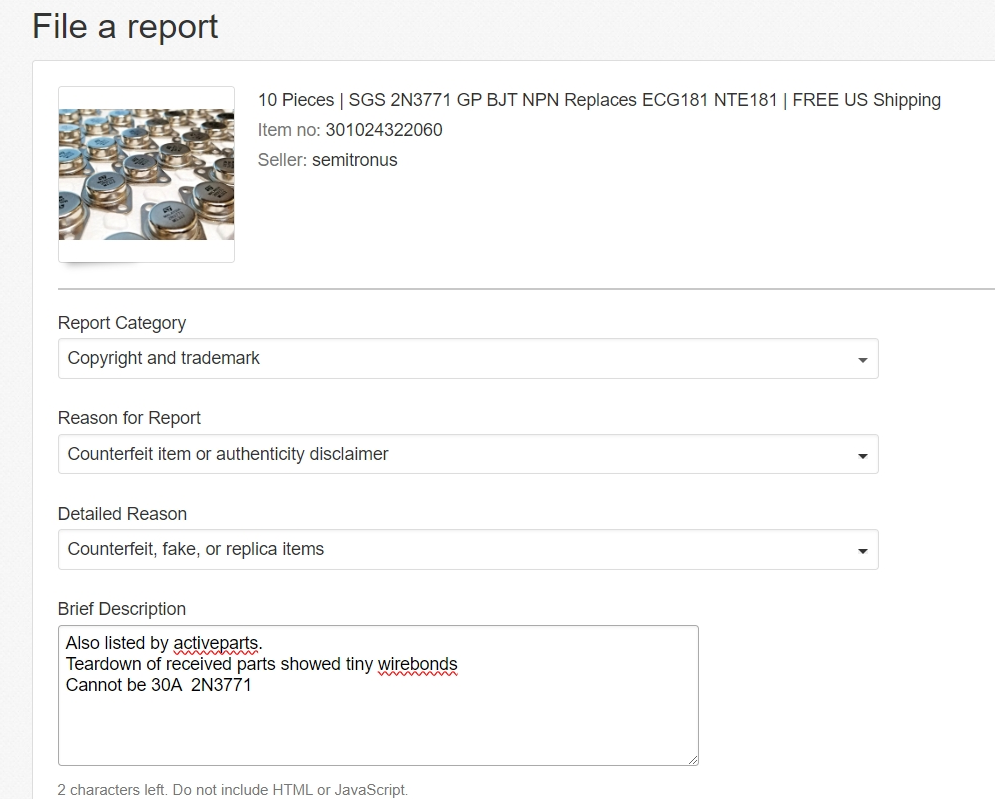
The form leads you down a very narrow decision tree. For instance if you claim “eBay item infringes on intellectual property rights,” you are instructed to use the VeRO reporting, only available to “rights owners.” In the “brief description” you are allowed 100 characters to make your case. Please hear no evil! Then you are left with a “trust us and don’t come back” message.
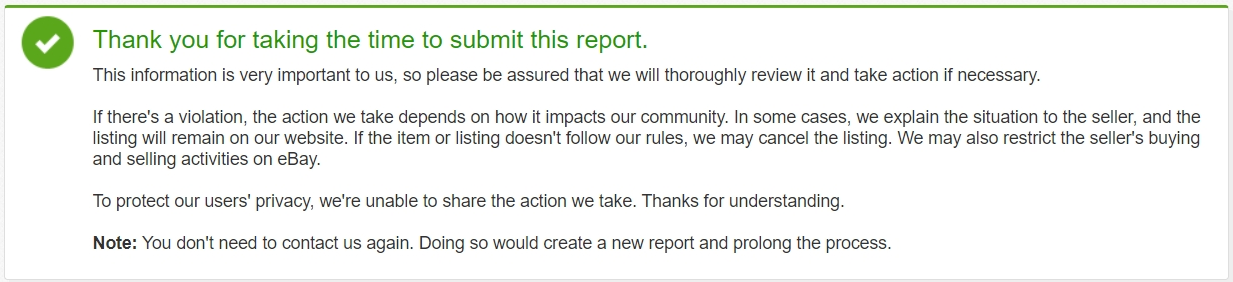
It has been several weeks now since I started this process. Never did my “review” get published, maybe because my negative “feedback” item was already a black eye for the seller. The seller, and it’s mother-in-law store, still continues to list the offending parts. I’ve not heard back from eBay. A look around the electronics blog-o-sphere reveals that the same seller has been at this for a long time. Well documented fakes purchased from this seller date back to 2016. I don’t expect anything to change.
Amazon’s Brands and Sellers
Looking for the source of bad parts, I continually ran into weird “brands” for products. The one that started me down this road was the YEGAFE “brand” that I saw on some of the 2N3771’s I was searching for on eBay. A little Googling and it showed up on Amazon and other places as well, associated with parts ranging from capacitors, cable assemblies, to semiconductors. The brand even showed up in a supposedly impartial “review” of the “best” IGBT’s. You might expect that the manufacturer of one of the “best IGBTs” would at least have a website — but you will not find one. This “review” was actually click bait shilling for Amazon. The brands it “reviewed” included such show stoppers as Todiys, Bridgold, Chanzon, Reland Sun and YEGAFE. Missing from the review were any of the manufacturers I would be curious about such as ON Semiconductor, ST Microelectronics, or Infineon.
Among the electronics parts dealers on Amazon are a few off brands that appear frequently and also appear at the USPTO as registered trademarks. Here are three, along with their registered addresses, in China naturally.
BOJACK Dongguan Yuhang Electronic Technology Co., Ltd.
Chashan Town, Dongguan, CN
Bridgold Wuhan Yidianjinqiao Automotive Supplies Co., Ltd.
Room 280, Bldg A, Zhonghuan Bldg No. 31 Yunlin Street, Jiang’an District, Wuhan, CN
Chanzon Shenzhen Chanzon Technology Co., Ltd.
Room 2111, Baohua Building A, Huaqiang North Rd, Shenzhen, Guangdong, CN
These folks seem to act like they would like to have some brand recognition and build some loyalty and trust to their brand lines for the parts they manufacture and/or distribute. Many of the other “brands” of Amazon sellers don’t have a registered brand with the USPTO and there is no physical address or contact info available. Often the “brand” is listed as the “manufacturer,” though that certainly seems dubious in most cases.
If these are the best of the Amazon brands, can you trust them? Well here is a listing for my favorite part with the Bridgold brand in the ad but showing and ONsemi logo on the part in the picture.

You might notice that the markings on the part in their picture look identical to one of the fakes I tore apart.
AliExpress and Chinese Sellers
The little experiment buying the 2N3771’s from three different sellers on AliExpress also proved enlightening and also added more mystery. First, since I placed the orders at the same time, AliExpress consolidated the shipping so that all of the parts arrived in a single package with the three smaller packages inside. That made sense, but peculiar was my PayPal receipt.
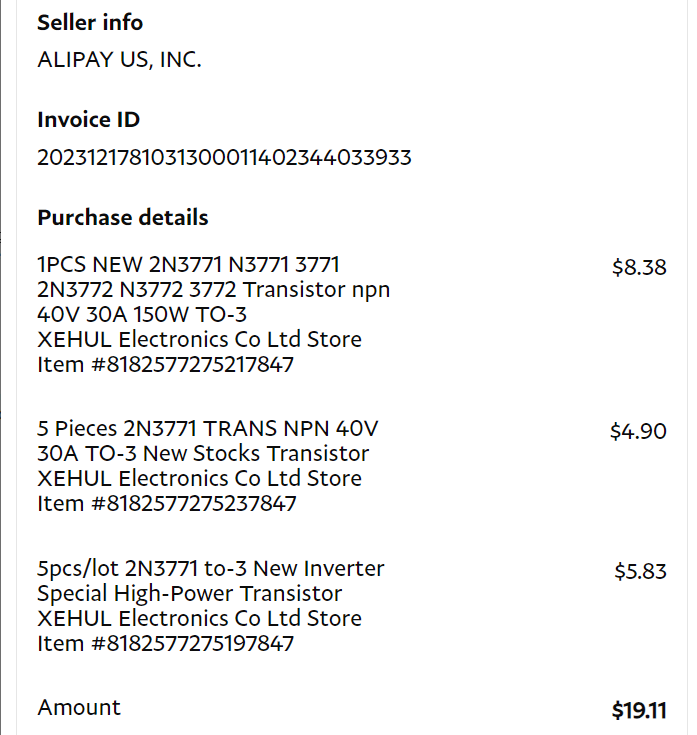
Note that all of the entries have the same XEHUL Electronics Store even though I bought from two other AliExpress vendors. Trying to Google the names of the stores gets you nowhere. However there is a small link to “Business License” when you hover over the store’s name on its home page that provides a small image with a real company name and a physical address.
For XEHUL Electronics Co. Store Ltd this is on the license info:
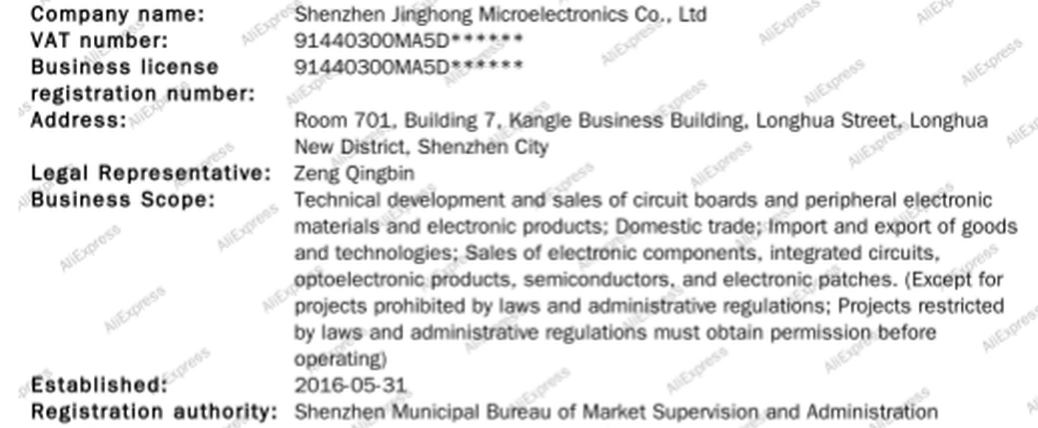
The two other stores seemed to have different addresses in Shenzhen, so not sure why they were billed on the PayPal invoice to the same entity. Searching for physical addresses with Google Maps is unsatisfactory in China. The map and satellite layers do not match – part of China’s obfuscations for security concerns as I understand it. Trying to track anything through the maze of Chinese storefronts, manufacturers, middlemen and language translations quickly leads to nowhere.
Conclusions
I came to this issue of fake parts by trying to procure some 2N3771 transistors, 40 year old parts with no intrinsic intellectual property left to steal, and easy-to-spot fakes in seconds with a Dremel tool. The fake 2N3771s is a red flag for all of the much harder-to-spot fakes out there. If you need to buy electronics parts there is little reason NOT to just go to reputable parts distributors such as Mouser, DigiKey, or Newark, etc. These folks stake their reputations on providing honest components.
Besides a big waste of time and money, fake parts can be dangerous. See here for an exploration of generic fuses that fail to fuse at their rated current. That kind of fake part could burn down your house.
Selling fake parts is rampant on all of the online marketplaces; buyer beware. Seller protections on eBay and other marketplaces are set up to promote sales more than protect buyers. On eBay, “Top Rated Sellers” have to be doing a significant amount of business and can’t be getting too many buyer complaints to get the rating. However, simply returning the buyer’s money will in many cases erase any blot on the seller’s record. Wasting a buyer’s time doesn’t enter into this metric. Dealers selling large quantities of new-looking obsolete parts should raise a red flag, “Top Rated” or not.
Anonymity breeds contempt. If you can’t figure out who is selling you an item or who made the parts you want to buy, chances are they really didn’t want you to know. Most online trading is done anonymously which leads to dishonesty. When the seller is just a middle man, they have to get their product somewhere. When weird Amazon brands show up on eBay, a look at the seller’s negative feedback might reveal that they are reselling Amazon products at elevated prices. Usually you can get the same stuff even cheaper directly from China on AliExpress.
So what is eBay good for? It can be a valuable auxiliary sales outlet for a legitimate business. This was the case when I bought some used Renogy solar panels or when I purchased an antenna controller I saw on eBay from a radio amateur who also sold through his website. And, eBay can turn your trash into someone else’s treasure, and help clean out your garage. But beware the hucksters!
References
- Andrew Lehrer Tiffany v. eBay: Its Impact and Implications on the Doctrines of Secondary Trademark and Copyright Infringement, BUJOSTL, Vol. 18.2 – Summer 2012.
- eBay User Agreement https://www.ebay.com/help/policies/member-behavior-policies/user-agreement?id=4259&st=3&pos=1&query=User%20Agreement&intent=user%20agreement&lucenceai=lucenceai&docId=HELP1313

