
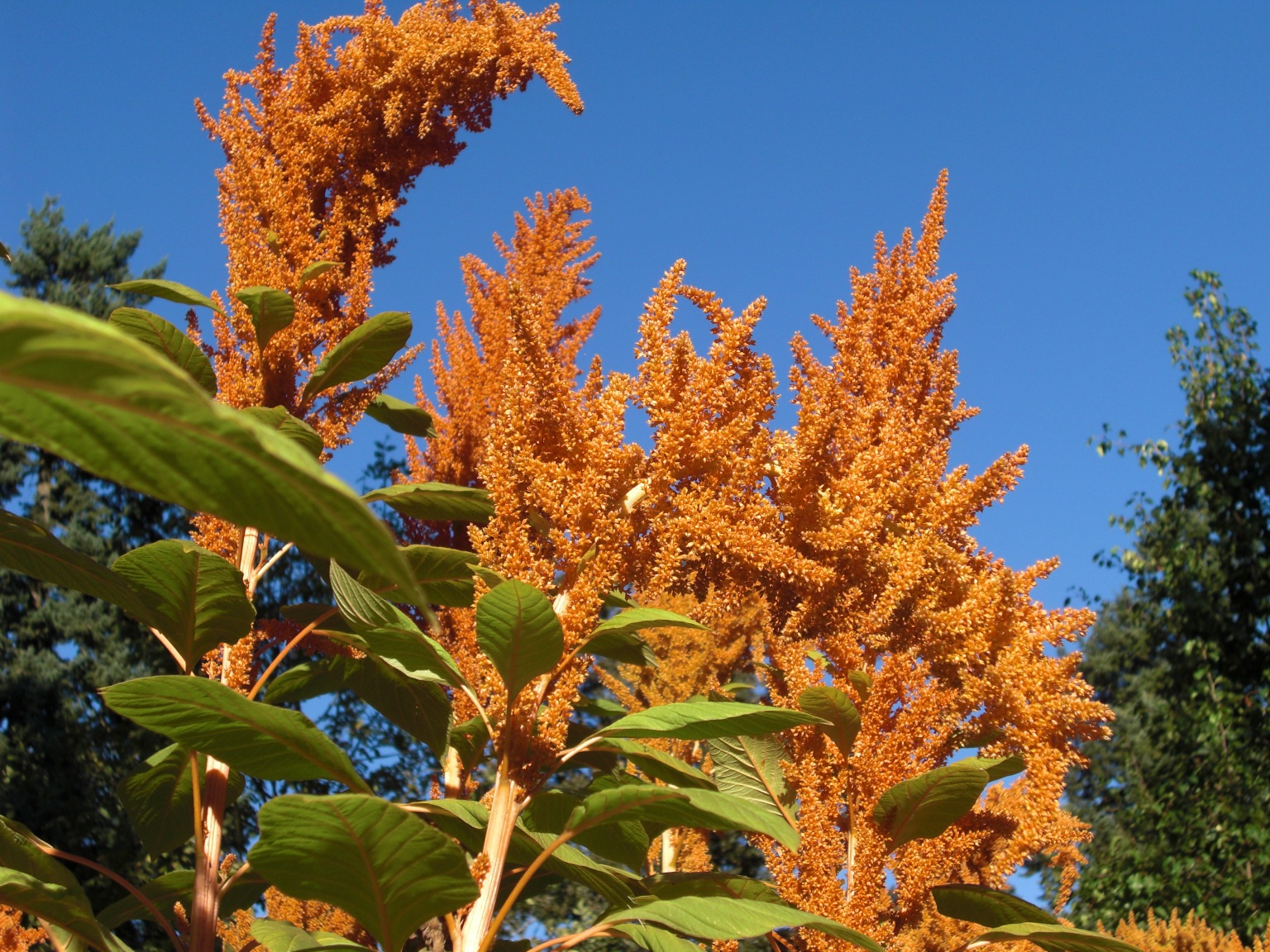
Update September 2023
I’ve been growing amaranth for more than a dozen years now, so it is time for a little update. The article below is still a good place to start if you wish to learn a little more about this fun and beautiful crop, but after doing this for a few years I have a system that is slightly less labor intensive and produces better product.
Plant spacing
Amaranth can be planted with just about any spacing and it will fill in the space allotted to it. Over the years I’ve planted by broadcasting seed and thinning and by transplanting out starts grown from seed in six-packs. I usually use the latter method because I can get a couple of weeks advance on soggy ground with the starts. However, lots of bugs like amaranth starts. When I first set out the transplants before they really start to grow, they can get predated by slugs and other bugs. Usually I have compost on some section of the garden that is sprouting volunteer amaranth seedlings. This year, predation was particularly bad and volunteer production on a squash hill was particularly good, so I re-transplanted almost every other transplant from the garden volunteers. These re-transplants took over. I ended up with about 60 plants on my 40 ft. by 4 ft. parking strip garden plot, three rows with a plant spacing around 2 ft. With this spacing the plants grew large, up to 10 ft. tall with flower heads 3-4 ft. long.

Harvest
A few things have changed in my hand harvest methods over the years. First, it is a really good idea to stop watering the plants a good month before you plan to harvest. And it is very nice to have good weather at harvest time, so here in Oregon that means mid August is the last water date. The plants are large and flowering and they will continue for quite a while this way, but the dry soil will help to let the plants know it is time to set the seed heads.
I still use the wheelbarrow with a screen frame to catch flower scraps, but now I cut the stalks as I harvest. I originally thought I might get more grain, or the flowers would look nice after shaking the seed and wanted to leave them standing – but not worth it. Nothing more comes and the flowers look horrible after a day or two post harvest. So cut the stalks, save your back, and rub each flower stem thoroughly over the wheelbarrow.
Processing the Grain
Winnowing and drying the grain has evolved over the last decade. I will still emphasize keeping everything clean – once dirt gets in it stays there. When freshly harvested the amaranth grain is too large to easily pass through window screen. When harvesting I pass the wheelbarrow contents through a 1/8″ hardware cloth screen again to remove big stuff, and if a breeze is blowing you can winnow some of the chaff, but the process will be much more efficient with less loss once the grain has dried enough to be screened through a window screen mesh. So place the harvest in a couple of big buckets out in the sun and stir it frequently to begin the drying process. It is really nice to have a few days of sun to get the drying underway. After a couple of days the grain can be filtered with the window screen. Shake it all through and discard what does not pass the screen. At this pont it takes only a slight breeze to be able to winnow the remaining chaff from the grain. Keep drying the grain further. The last thing you want is to have the grain mold in the jar, so be patient with the drying process.
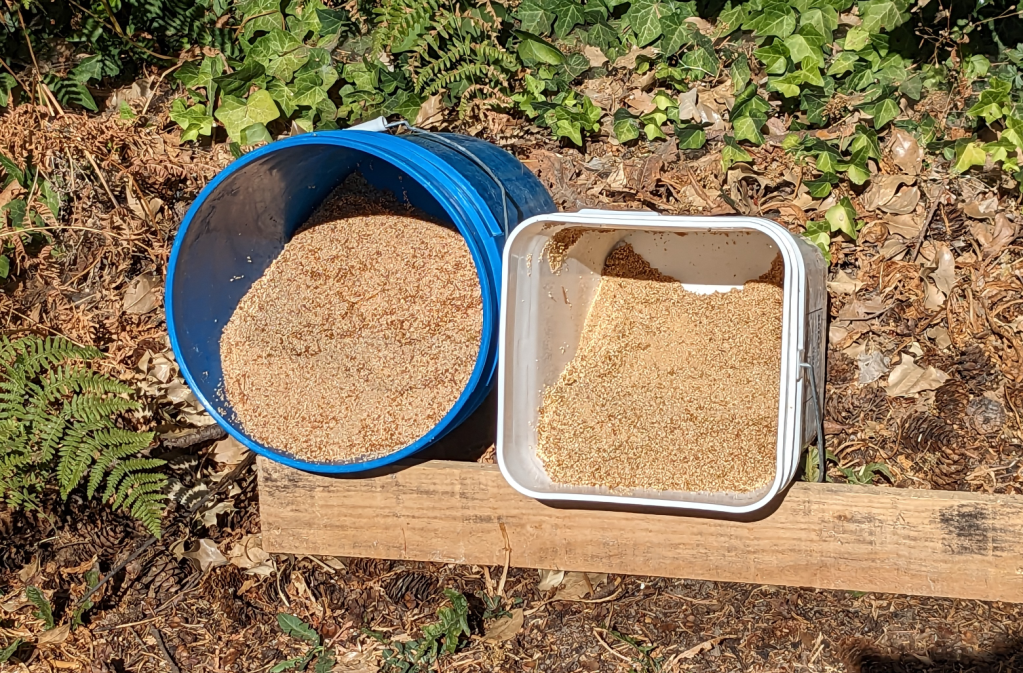
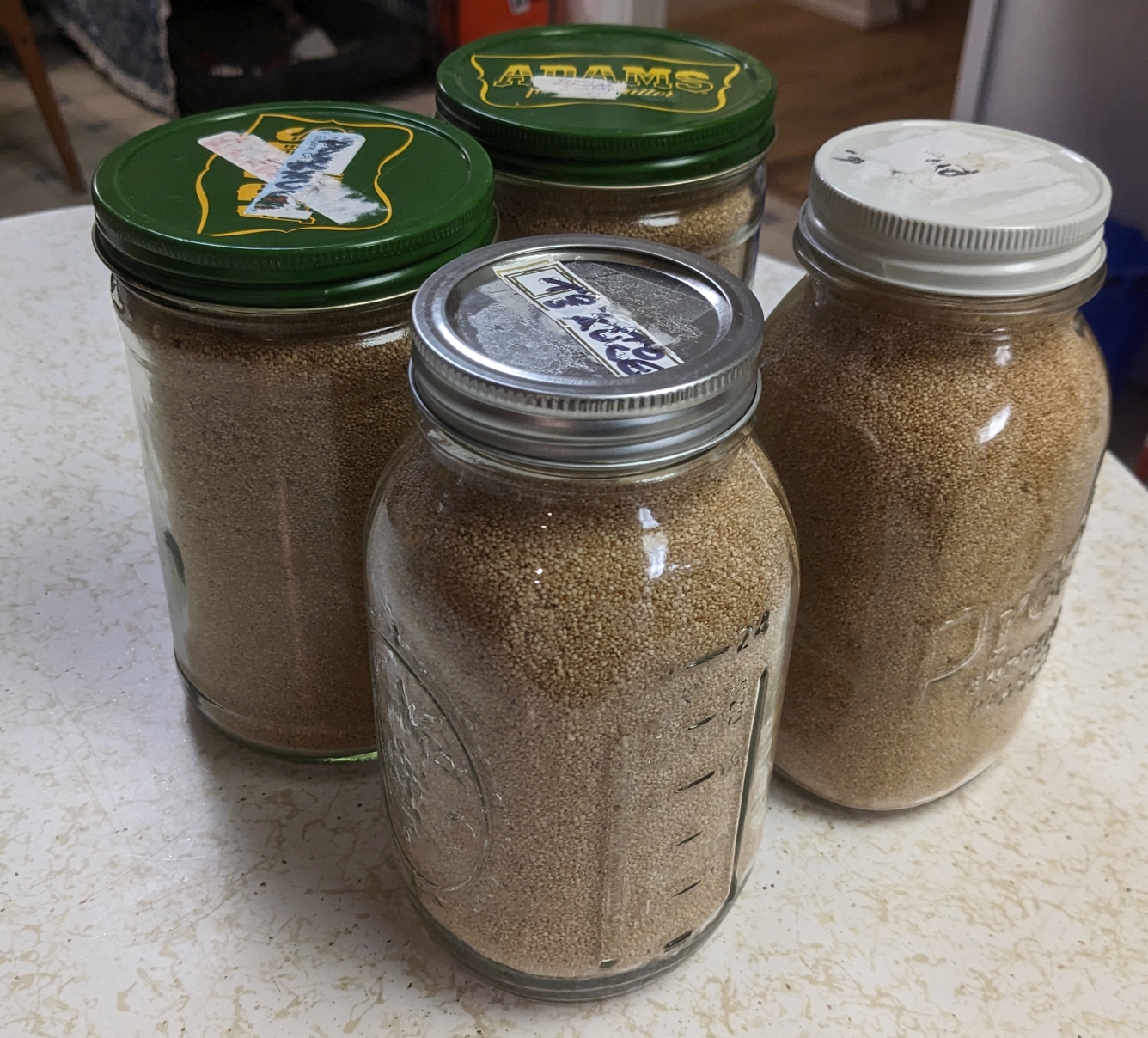
Drying freshly harvested gain in the sun… and the 2023 harvest, about 7 lbs.
The 2010 Blog Post
Of all the grain crops, amaranth has to be the easiest to turn into something that you can eat. If you have ever wondered how to add a cereal crop to your garden, consider amaranth. This versatile, beautiful, and easy to grow plant can add another dimension to gardening. Unlike wheat or oats, where you need to cut the stalks, thresh the grain and then grind it into flour, amaranth literally falls from the seed heads ready to eat.
I started this experiment last year with a small test crop just to get an idea of what to expect. Andrew Still of the Seed Ambassadors spoke highly of amaranth and gave me a few seeds of Copperhead, an ornamental yet grain producing variety. There are two or three species of grain amaranth, Amaranthus caudatus, and Amaranthus cruentus (Copperhead is this species) being the most important, each of which encompasses many varieties. Most of the amaranth varieties have purple or red hues in the plant stalks and leaves as well as brilliantly colored flowers. Copperhead is an exception with rust and copper tones in the stems and flowers. The common commercial variety called Plainsman is a hybrid of two other species, Amaranthus hypochondriacus, from Mexico and Amaranthus hybridus, from Pakistan. Plainsmen is a recent development initiated at the Rodale Institute and completed at the University of Nebraska to develop a high-yielding crop suitable for mechanical harvest. A good discussion on the potential of amaranth as a commercial crop can be found at the Purdue University NewCROP website here.
Last year I started a few seeds indoors and set out the seedlings far too close together for the size of plants that were to come. Despite the crowding, and half the plants in pretty deep shade, the flowers were magnificent and I got a couple of cups of grain. This year, forearmed with a little bit of knowledge, and looking for a more significant crop, I committed the parking strip along the street to amaranth. I was intending to sow directly this year, but when planting time came the weather was still cool and wet so I again started plants inside. The bottoms of two milk jugs as flats produced about 150 seedlings.
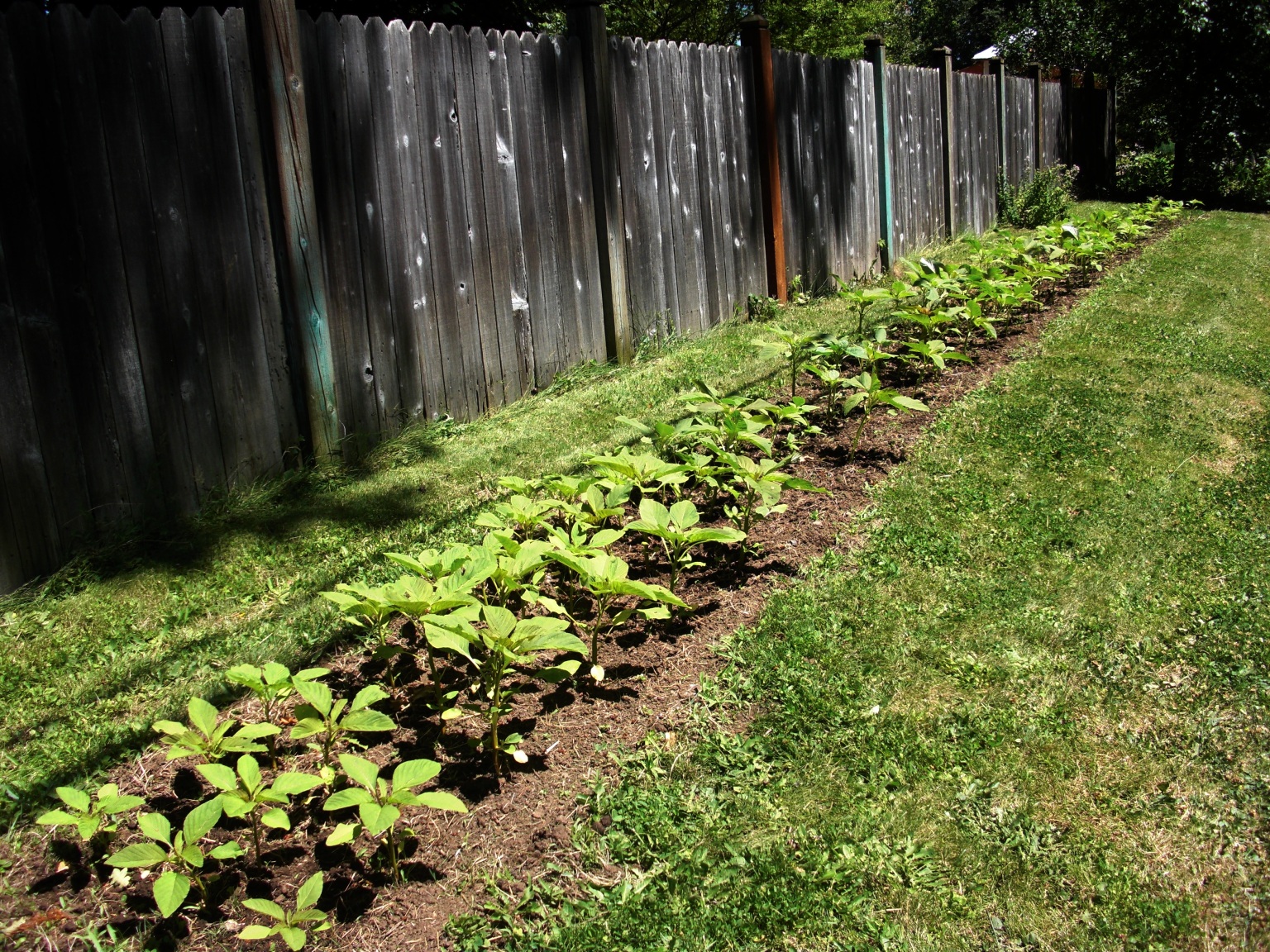
I planted the the bed in about three rows a foot apart with 1 to 2 feet between plants in the rows. Most of the seedlings quickly became established. The photo shows the bed in the middle of July, about five weeks after transplanting. I did weed the bed a couple of times. Once the stand became established, in August, I seeded a bit of crimson clover under the canopy to try and get the eventual winter cover crop established early.
Like many of the more vigorous growers, amaranth is a C4 plant with an advantage in efficiency of photosynthesis. Amaranth is closely related to pig weed, so it’s not surprising that it grows like a weed! A volunteer sunflower came up in the patch and the amaranth grew almost as fast as the sunflower.

By the end of September the seed heads were filling out and getting heavy. Amaranth easily gives up its seed. You can test the flowers just by gently rolling them in your hand. If the seeds are ripe they will fall into your hand. Despite the apparent fragility of the flowers, the seed heads don’t seem prone to shattering. This year, as with everything else, fall came too quickly and the seed heads on the shady end of the bed never got fully ripe before weather dictated harvest time.

I harvested the grain by gently bending the seed heads over a screen placed over the wheel barrow. I then vigorously rubbed the the flower heads with my hands as the grain sprinkled through the screen. The screen of 1/8″ hardware cloth would catch most of the large flower parts that were dislodged. This process is relatively gentle to the plants. I was hoping we might have a long dry fall and I would have a chance for a second harvest, but that didn’t happen this year.
I transferred the contents of the wheel barrow to a five gallon plastic bucket. I used a small fan to winnow the fresh grain from the flower fluff that comes along with the grain. Slowly pouring the grain from one bucket into another in front of the fan, most of the fluff gets separated from the grain. Winnowing does a good job with amaranth because the seeds are dense and compact compared to the flower fluff. After the seeds had dried a few days, I screened everything through window screen. When the seed is fresh it will not fit through the window screen mesh, but it does once it loses some of its moisture. It’s important to keep the grain clean throughout the processing steps. Fluffy stuff will get winnowed away, but bits of dirt will remain with the seed.
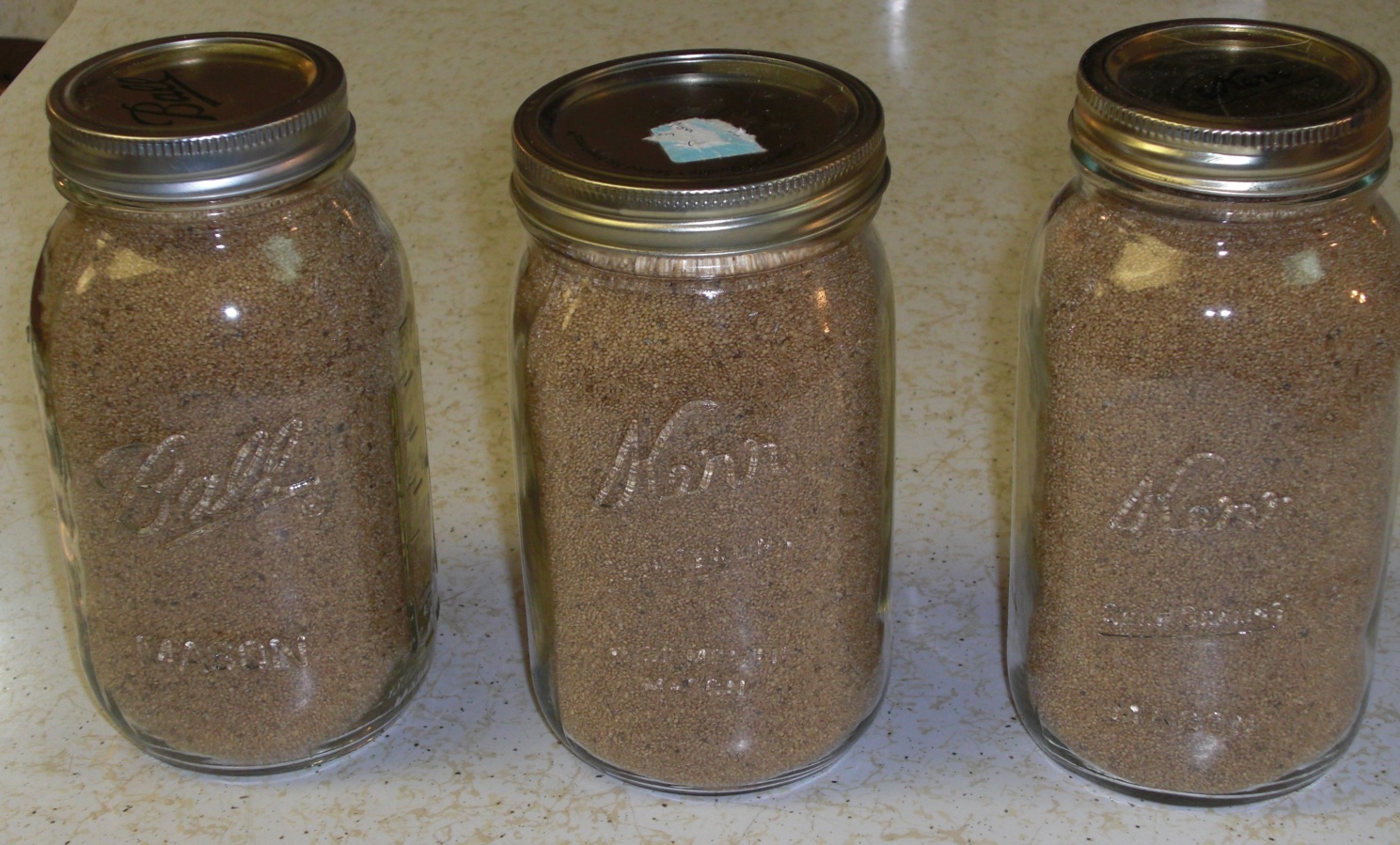
The fresh grain contains a lot of moisture and it must be dried down. I spread the grain thinly in my plastic buckets and turned it frequently. The harvest shrinks as this process continues. What started out as almost a five gallon bucketful of grain and fluff has turned into just three quarts of grain for my efforts. I was hoping for more, but this will still yield a few good breakfasts through the winter! Actually my harvest is not too far from amaranth expectations. The literature suggests yields around 1000 lb./acre can be expected. I have 5-6 lbs. from about 180 sq.ft. which translates to about 1300 lb./acre.
As usual, I’m already planning the next phase. Perhaps next year I’ll plant a little more, it will be warmer, and I’ll get a bumper crop. I have some grain amaranth that I got at the natural food store that I am curious to plant as well. It’s probably Plainsman; it would be an interesting comparison.
 Squash Practice
You may also consider Amaranthus viridis, a cosmopolitan plant, and an edible vegetable in many places including India and Pakistan.
Tell me more… Have you tried viridis? For seed or greens?
Hi Gary, I see your post is over a year old. I wonder if you have learned more since then?
Hi covercropper, Last year we had a cool spring and early summer (we seem to be getting that again this year as well) which resulted in getting things planted late. I tried growing some amaranth from seed that I picked up at the health food store which I since concluded was probably ‘plainsman’. Unfortunately, between the late start and the longer growing season required by this variety, I didn’t get much of a harvest. I have a few more details in this post:
Thanks Gary, as you can see I am looking for experienced folk who have tried amaranth as a cover crop. You post gives me some ideas, and reiterates a suggestion that amaranth is best sown in ‘late spring’, which nearly suits me.
Happy gardening and blogging.
Would you harvest the amaranth or just plow it in again? Amaranth is a C4 plant so it is efficient at photosynthesis, but it likes fertilizer. The stalks can get bigger than corn stalks, so can generate a lot of biomass, but its not readily composted in place. My favorite cover crop here in the Pacific Northwest are fava beans. Favas grow through the winter and are a nitrogen fixer – but we have a lot of rain that they need.
Hi Gary,
Sorry, my blog is so new yet I haven’t outlined my vision, plan, or touched on the most pressing questions. Stay tuned…
Anything I grow will be in a mix, grown only for 2 to 4 months, and grazed or sprayed off, and left in situ. Or rolled and sprayed. It is supposed to provide the mulch for the following no-till winter crop. If the crop is a cereal, the remaining cc can remain standing, if it can. If a legume, it will be harvested off at ground level anyway. Nutrient cycling is not my first goal. My last post happened to be about amaranth, so it is top of mind.
Hi Gary’where can i buy seeds?
Anita
Hi Anita,
Try Adaptive Seeds http://www.adaptiveseeds.com/product/amaranth-copperhead
Good Luck!